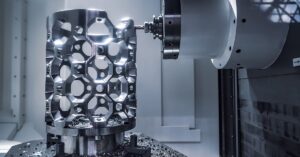
CNC automation refers to the use of computer systems to control and automate manufacturing processes. It involves the use of computer programs to control machine tools and equipment, such as lathes, mills, routers, and grinders. CNC automation has become an integral part of modern manufacturing due to its ability to improve productivity, accuracy, and efficiency.
The importance of CNC automation in manufacturing cannot be overstated. It has revolutionized the way products are made, allowing for faster production times, higher precision, and increased flexibility. By automating repetitive tasks and reducing human error, CNC automation has significantly improved the quality and consistency of manufactured goods. It has also led to cost savings by reducing labor costs and minimizing waste.

The Evolution of Manufacturing with CNC Automation
The history of CNC automation can be traced back to the 1940s when the first numerical control (NC) machines were developed. These early machines used punched cards or magnetic tapes to control the movement of machine tools. However, it was not until the 1970s that CNC technology became widely adopted in the manufacturing industry.
Technological advancements in CNC automation have been driven by the development of more powerful computers and software. In the early days, CNC machines were limited in their capabilities and were primarily used for simple tasks such as drilling holes or cutting straight lines. However, with the advent of more advanced software and hardware, CNC machines can now perform complex operations such as 3D milling, turning, and grinding.
Advantages of CNC Automation in Manufacturing
One of the main advantages of CNC automation in manufacturing is increased productivity and efficiency. CNC machines can work continuously without breaks or fatigue, allowing for faster production times and higher output. They also eliminate the need for manual intervention in repetitive tasks, freeing up workers to focus on more complex and value-added activities.
Another advantage of CNC automation is improved accuracy and precision. CNC machines are capable of making highly precise movements and cuts, resulting in products that meet tight tolerances. This level of precision is difficult to achieve with manual machining methods, which are prone to human error. CNC automation also allows for the replication of complex shapes and patterns with ease, ensuring consistency in the final product.
Cost-effectiveness is another key advantage of CNC automation. While the initial investment in CNC machines may be higher compared to traditional machines, the long-term cost savings can be significant. CNC machines require less maintenance and have a longer lifespan, reducing downtime and repair costs. Additionally, CNC automation reduces labor costs by eliminating the need for skilled operators to manually control the machines.
The Role of Robotics and Artificial Intelligence in CNC Automation
The integration of robotics and artificial intelligence (AI) has further enhanced the capabilities of CNC automation in manufacturing. Robotics refers to the use of robots to perform tasks traditionally carried out by humans, while AI involves the use of computer systems to simulate human intelligence and decision-making.
In CNC automation, robotics can be used to automate material handling, loading and unloading of parts, and other repetitive tasks. This not only improves productivity but also reduces the risk of injuries to workers. Robots can also be equipped with sensors and vision systems to perform quality control checks during the manufacturing process, ensuring that products meet the required specifications.
AI technology can be used to optimize CNC machining processes by analyzing large amounts of data and making real-time adjustments. For example, AI algorithms can monitor machine performance and make adjustments to speed, feed rate, or tooling based on factors such as temperature, vibration, or tool wear. This helps to improve efficiency and reduce waste by minimizing errors and maximizing machine utilization.
The Impact of CNC Automation on Manufacturing Processes
CNC automation has had a profound impact on manufacturing processes, leading to significant improvements in quality control, flexibility, and customization.
With CNC automation, manufacturers can implement rigorous quality control measures to ensure that products meet the required specifications. CNC machines can be programmed to perform in-process inspections and measurements, reducing the risk of defects and non-conformities. This level of quality control is difficult to achieve with manual machining methods, which are more prone to human error.
CNC automation also allows for increased flexibility in production. Traditional manufacturing methods often require dedicated machines for specific tasks, making it difficult to switch between different products or make changes to the production process. With CNC automation, manufacturers can easily reprogram machines to produce different parts or make modifications to the design. This flexibility enables manufacturers to respond quickly to changing customer demands and market trends.
The Future of CNC Automation in Manufacturing
The future of CNC automation in manufacturing looks promising, with several emerging trends and potential advancements on the horizon.
One emerging trend is the integration of additive manufacturing, or 3D printing, with CNC automation. Additive manufacturing allows for the production of complex geometries and customized parts that are difficult or impossible to achieve with traditional machining methods. By combining 3D printing with CNC automation, manufacturers can take advantage of the strengths of both technologies, resulting in faster production times and increased design freedom.
Another potential advancement in CNC automation is the use of machine learning algorithms to optimize machining processes. Machine learning involves training computer systems to learn from data and make predictions or decisions without being explicitly programmed. By analyzing large amounts of data from CNC machines, machine learning algorithms can identify patterns and optimize machining parameters to improve efficiency and reduce waste.
Challenges and Limitations of CNC Automation in Manufacturing
While CNC automation offers numerous benefits, there are also several challenges and limitations that need to be addressed.
One technical challenge is the complexity of programming CNC machines. Writing code for CNC machines requires a high level of skill and expertise, which can be a barrier for small manufacturers or those with limited resources. However, advancements in software and user-friendly interfaces are making it easier for operators to program CNC machines without extensive programming knowledge.
Economic challenges also exist, particularly for small and medium-sized enterprises (SMEs). The initial investment in CNC machines can be significant, and the cost of training operators and maintaining the machines can also be a burden for SMEs with limited budgets. However, as CNC technology becomes more widespread and competition increases, the cost of CNC machines is expected to decrease, making them more accessible to smaller manufacturers.
Social and ethical challenges are also associated with CNC automation. The widespread adoption of CNC automation has raised concerns about job displacement and the impact on the workforce. While it is true that some jobs may be replaced by CNC machines, new job opportunities are also emerging in areas such as programming, maintenance, and quality control. It is important for manufacturers to invest in training and skill development programs to ensure that workers are equipped with the necessary skills to adapt to the changing job market.
Training and Skill Development for CNC Automation in Manufacturing
Training and skill development play a crucial role in maximizing the benefits of CNC automation in manufacturing. It is important for manufacturers to invest in training programs to ensure that operators have the necessary skills to program, operate, and maintain CNC machines.
There are various types of training programs available for CNC automation, ranging from basic introductory courses to advanced programming and troubleshooting workshops. These programs can be offered by machine manufacturers, technical schools, or industry associations. Online resources and tutorials are also available for self-paced learning.
In addition to technical skills, it is also important for operators to develop problem-solving and critical thinking skills. CNC automation requires operators to analyze data, make decisions, and troubleshoot issues that may arise during the machining process. By providing comprehensive training programs that focus on both technical and soft skills, manufacturers can ensure that their workforce is well-equipped to handle the challenges of CNC automation.
Case Studies of Successful Implementation of CNC Automation in Manufacturing
There are numerous examples of companies that have successfully implemented CNC automation in their manufacturing processes.
One such example is Haas Automation, a leading manufacturer of CNC machines. Haas Automation has embraced CNC automation in its own production facilities, using its own machines to manufacture parts for its products. By leveraging the capabilities of CNC automation, Haas Automation has been able to increase productivity, improve quality control, and reduce lead times.
Another example is Tesla, the electric vehicle manufacturer. Tesla has implemented CNC automation in its production facilities to manufacture various components for its vehicles, including battery packs and drivetrain systems. By using CNC machines, Tesla has been able to achieve high levels of precision and consistency in its manufacturing processes, resulting in high-quality products.
Why is CNC Automation so important in Revolutionising Manufacturing
CNC automation has revolutionized the manufacturing industry by improving productivity, accuracy, and efficiency. It has enabled manufacturers to produce high-quality products at a faster pace and with greater precision. The integration of robotics and AI has further enhanced the capabilities of CNC automation, allowing for increased flexibility and optimization of machining processes.
While there are challenges and limitations associated with CNC automation, such as the complexity of programming and the potential impact on the workforce, these can be overcome through training and skill development programs. By investing in training and embracing CNC automation, manufacturers can position themselves for success in the increasingly competitive global market.
The future of CNC automation looks promising, with emerging trends such as the integration of additive manufacturing and machine learning on the horizon. As technology continues to advance, there is great potential for further advancements in CNC automation that will continue to revolutionize the manufacturing industry. It is important for manufacturers to embrace these advancements and stay ahead of the curve to remain competitive in the rapidly evolving manufacturing landscape.